Dearborn Water Damage Restoration › Water Damage Restoration
Dealing With Water Damage in Dearborn
Wet carpet and swollen baseboards mean water went deep. Meters guide the drying of your structure after we remove the water. The median home in Dearborn was built in 1952, so a typical house here carries 1950s plumbing and wiring.
For Dearborn, the typical response clocks in under 30 minutes. A crew starts moving toward your address as soon as you call.
Every job is covered by a written guarantee built on finishing the job, not refunding it.
The Dearborn Headquarters
Crews for Dearborn jobs leave from our local headquarters: 23756 Michigan Ave, Dearborn, MI 48124, Ste 200 (HNH Law Office Centre). The Local Headquarters sits on Michigan Avenue in West Dearborn's historic main corridor, so most of the city is a short drive away.
Related guide: Dearborn Storm Drains, Sewers and Basement Backups
Know This If You Live in Dearborn
The Homes in This City
About 46 percent of Dearborn homes (18,247 of 39,394) went up in 1949 or earlier, and about 84 percent (33,016) went up before 1980, which puts most of the stock in the lead-paint and asbestos-material era. (U.S. Census Bureau ACS 2020-2024 5-year)
Dearborn has 25,098 owner-occupied and 11,597 renter-occupied households, so about 68 percent of households own their home. (U.S. Census Bureau ACS 2020-2024 5-year)
About 74 percent of Dearborn housing units are detached single-family houses (29,125 of 39,394). Another 2,528 units sit in buildings of 50 or more units. (U.S. Census Bureau ACS 2020-2024 5-year)
Ford built the first planned Dearborn subdivision, the Ford Homes District, with 250 houses in six designs for white-collar Ford employees around 1919-1920. (The Henry Ford, Ford Homes Historic District photograph)
In the Springwells Park neighborhood, 60 percent of lots had houses by the start of World War II, another 30 percent were built right after the war, and the last 10 percent between 1960 and 1988. (Wikipedia, Springwells Park Historic District)
Springwells Park houses are one, one-and-a-half or two stories with gable roofs and Colonial Revival detail. Types include Cape Cods, center-entrance two-stories, cottages and ranches, in brick, stone or clapboard. (Wikipedia, Springwells Park Historic District)
Springwells Park townhouses have two-story red brick walls and hip roofs covered in concrete tile. Its U-shaped terrace apartments have center entrances and cupolas. (Wikipedia, Springwells Park Historic District)
Springwells Park has curving streets, cul-de-sacs and public walkways, unlike the grid that covers most of Dearborn. A local history says it is the only Dearborn neighborhood with this walkway feature. (Springwells Park Association, A History of Springwells Park...)
A neighborhood history names Dearborn Hills and the post-war bungalows of southwest Dearborn as different styles, and calls Levagood Park in the northwest much newer by comparison. (Springwells Park Association, A History of Springwells Park...)
The same history places River Bend along Cherry Hill and Military in old Dearborn, and says the Ford Homes of the early 1920s have a style of their own. (Springwells Park Association, A History of Springwells Park...)
Water supply
Dearborn says it will replace all lead water service lines within twenty years, in step with its water main replacement work. (City of Dearborn, Water Services)
Dearborn residents under financial hardship can ask Wayne Metro's WRAP program for water bill help, at 313-386-9727. (City of Dearborn, Water Services)
Roads, Access and Travel
Rail lines cut through Dearborn: CSX's Detroit Subdivision, Grand Trunk Western's Dearborn Subdivision, a Conrail yard track, and Amtrak's Michigan Line at the John D. Dingell Transit Center. Most freight is automotive. (https://en.wikipedia.org Wikipedia, Dearborn, Michigan)
Dearborn has no frontage on the Detroit River. The Rouge was widened and channeled near the Rouge Plant for lake freighters. (Wikipedia, Dearborn, Michigan)
The Springwells Park Historic District sits in northwest Dearborn, bounded by Rotunda Drive, the Michigan Central Railroad line, and Greenfield and Eastham Roads. It joined the National Register on April 28, 2015. (Wikipedia, Springwells Park Historic District)
Dearborn has 11 registered neighborhood associations, including Snow Woods, Golfview Oaks, Riverbend, Morley Area, West Lane, Dearborn Hills and Country Club Estates. (City of Dearborn, Registered Neighborhood Associations map...)
Dearborn Permits and Rules
Selling a Dearborn home needs a city pre-sale inspection and a Certificate of Occupancy before closing, with all cited violations corrected and re-inspected. (City of Dearborn, Selling or Buying a Home)
Dearborn rental homes need a Certificate of Occupancy that expires 3 years after the first inspection, then a new inspection. (City of Dearborn, Step 6: Certificate of Occupancy)
In Dearborn, permits for repair work from an inspection must be pulled by a contractor registered with the city. (City of Dearborn, How to Submit for Re-Occupancy)
Dearborn plan review for permits takes 5 to 10 business days. Every permit needs an inspection that the applicant books in BS&A, and the stamped plans must stay on site. (City of Dearborn, Home Improvement & Construction)
Springwells Park holds a local historic district designation from Dearborn City Council (1992) and National Register listing (2015). The neighborhood is also deed restricted, and only Dearborn Hills (1926) shares that status. (Springwells Park Association, A History of Springwells Park...)
Springwells Park deeds specified brick, brick with stone trim, or brick and frame, and the original deed restrictions fixed the exterior materials. (Springwells Park Association, A History of Springwells Park...)
Dearborn advises a battery-backup sump pump and a licensed-contractor evaluation before installing one. The city says power loss is common in severe storms. (City of Dearborn, Flood Preparedness & Recovery)
Local Programs and Contacts
A FEMA hazard mitigation grant pays for about 6,200 feet of new storm sewer in Dearborn. FEMA covers 90 percent of cost and the city covers 10 percent. (City of Dearborn, FEMA grant announcement)
A federal grant is building four flap gates and two pumps as backflow preventers in East End neighborhoods, which protects about 13,600 residents from basement flooding. (City of Dearborn, Mayor Hammoud unveils current and future...)
The city cleared logjams from the Rouge River, which raised its capacity to move water out of Dearborn by 70 percent. It also turned 24 residential easements on Morrow Circle into bioswales. (City of Dearborn, Mayor Hammoud unveils current and future...)
Dearborn drains northeast neighborhoods through the 12-foot-wide Colson-Palmer stormwater line to the Rouge River. Clearing debris from it restores a 7 million gallon capacity, and a new headwall with gates and pumps keeps river backwater out. (City of Dearborn, Mayor Hammoud unveils current and future...)
Dearborn expects $27 million in federal disaster recovery funds after the 2021 flood, and its largest proposed project is the Colson Palmer Stormwater Line to the Rouge River. (Michigan Public, Dearborn is taking aggressive new measures...)
Dearborn's fire department proposed to stock and warehouse flood response kits for residents hit by flooding, paid from disaster recovery grant money. (City of Dearborn, Flood Preparedness & Recovery)
Grant money also funds a Green Schoolyard at Salina Schools in southeast Dearborn, with rain gardens, pollinator gardens and trees. (City of Dearborn, Flood Preparedness & Recovery)
Dearborn says it spent $25 million on flood work while its study ran, and it added a four-person crew that cleans sewer grates and catch basins. (City of Dearborn, Mayor Hammoud flood projects (2025-09-25))
After hours, Dearborn residents report a water main break to the Police Department Dispatch Center at 313-943-2100. During business hours the line is 311 or 313-943-2150. (City of Dearborn, Water Services)
For permit inspection help, Dearborn gives 311 or the email DBNInspections@dearborn.gov. Miss Dig supplies sewer and water main locations. (City of Dearborn, Home Improvement & Construction)
Other Local Facts
In June 2021 Dearborn residents named electricity, air conditioning and hot water as their most urgent needs, and mold and sewage residue as the main safety worries. (Michigan Public, Hammoud talks flood cleanup in Dearborn...)
Areas and Neighborhoods in Dearborn
- Springwells Park: Historic residential neighborhood in northwest Dearborn bounded by Rotunda Drive, the Michigan Central Railroad line, and Greenfield and Eastham Roads. (Wikipedia, Springwells Park Historic District)
- Ford Homes Historic District: 250 houses in six designs built around 1919-1920 for Ford white-collar employees. (The Henry Ford)
- Snow Woods: One of 11 city-registered neighborhood associations. (City of Dearborn neighborhood map)
- Golfview Oaks: One of 11 city-registered neighborhood associations. (City of Dearborn neighborhood map)
- Riverbend: One of 11 city-registered neighborhood associations. (City of Dearborn neighborhood map)
- Dearborn Hills: One of 11 city-registered neighborhood associations. (City of Dearborn neighborhood map)
- West Lane: One of 11 city-registered neighborhood associations. (City of Dearborn neighborhood map)
- Aviation Sub: A named Dearborn neighborhood whose housing a local history calls far different from Springwells Park. (Springwells Park Association, A History of Springwells Park (2026-02-14))
- Levagood Park: A northwest Dearborn neighborhood the same history calls much newer than the older districts. (Springwells Park Association, A History of Springwells Park (2026-02-14))
- Salina Schools area (southeast Dearborn): Site of a grant-funded Green Schoolyard in the area flooded in June 2021. (City of Dearborn, Flood Preparedness & Recovery)
- Morrow Circle: 24 residential easements here became bioswales built to absorb up to 40,000 gallons. (City of Dearborn, Mayor Hammoud flood projects (2025-09-25))
- East End: Target of four flap gates, two pumps and new manhole covers meant to cut basement flooding. (City of Dearborn, Mayor Hammoud flood projects (2025-09-25))
ZIP codes in Dearborn: 48120, 48121, 48123, 48124, 48126, 48128.
Everyday Failures That Flood Homes
- Under-sink connectors that loosen over time
- Water lines that burst in unheated spaces
- A water heater that gives out after years of use
- A power cut or motor burnout that stops the sump pump
- Snow and ice on the roof that leak into living areas
- Drain backups that bring sewage up through the floor
- Appliances that overflow or leak onto the floor
Check Your Home for These
- Even a thin film of water on tile or wood
- A damp smell that lingers
- Swollen trim or floors that ripple
- Spots on ceilings after storms
- Paint that bubbles or cracks
- Humid rooms that stay damp for hours
Recovery Steps We Follow
| Part | What we do |
|---|---|
| Source check | Technicians check the origin of the leak and whether it still flows. They close valves or stop leaks as a first aid step. A camera scan shows damp spots hidden behind walls. |
| Category and barriers | We identify the contamination class. Heavy contamination means sealed zones and protective suits. Light contamination needs less, though we still guard clean rooms. |
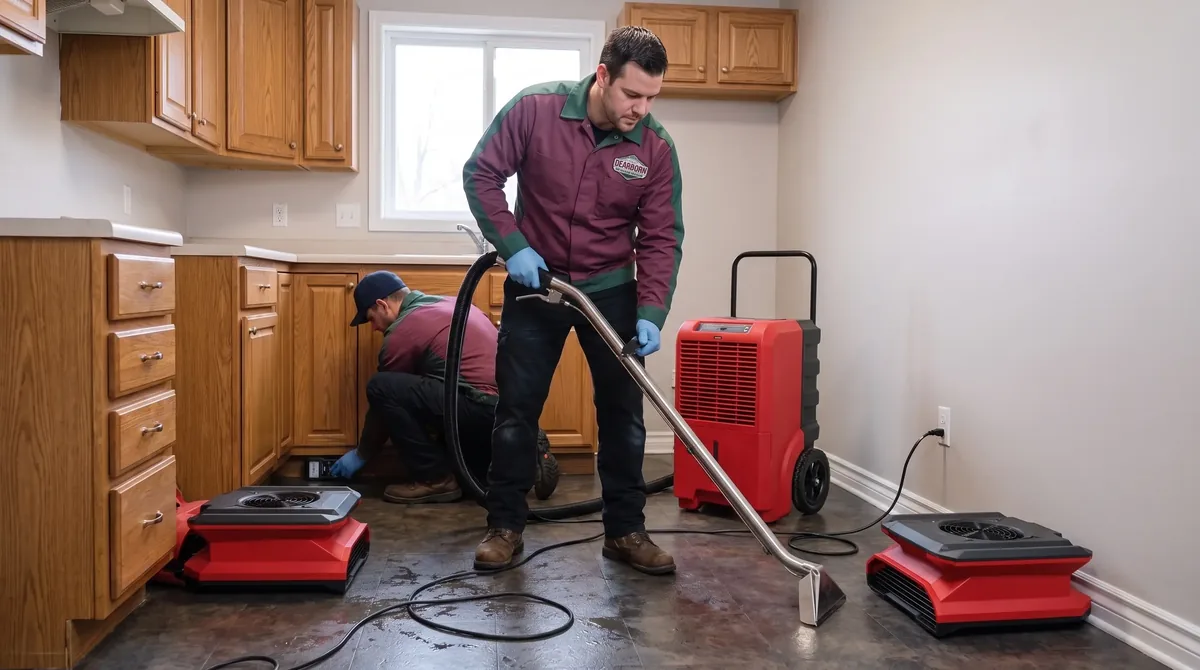
| Bulk water removal | Truck units and portable pumps remove water in volume. Hand tools reach corners and under cabinets. Water left in carpet and pad is pressed out or the material is removed. |
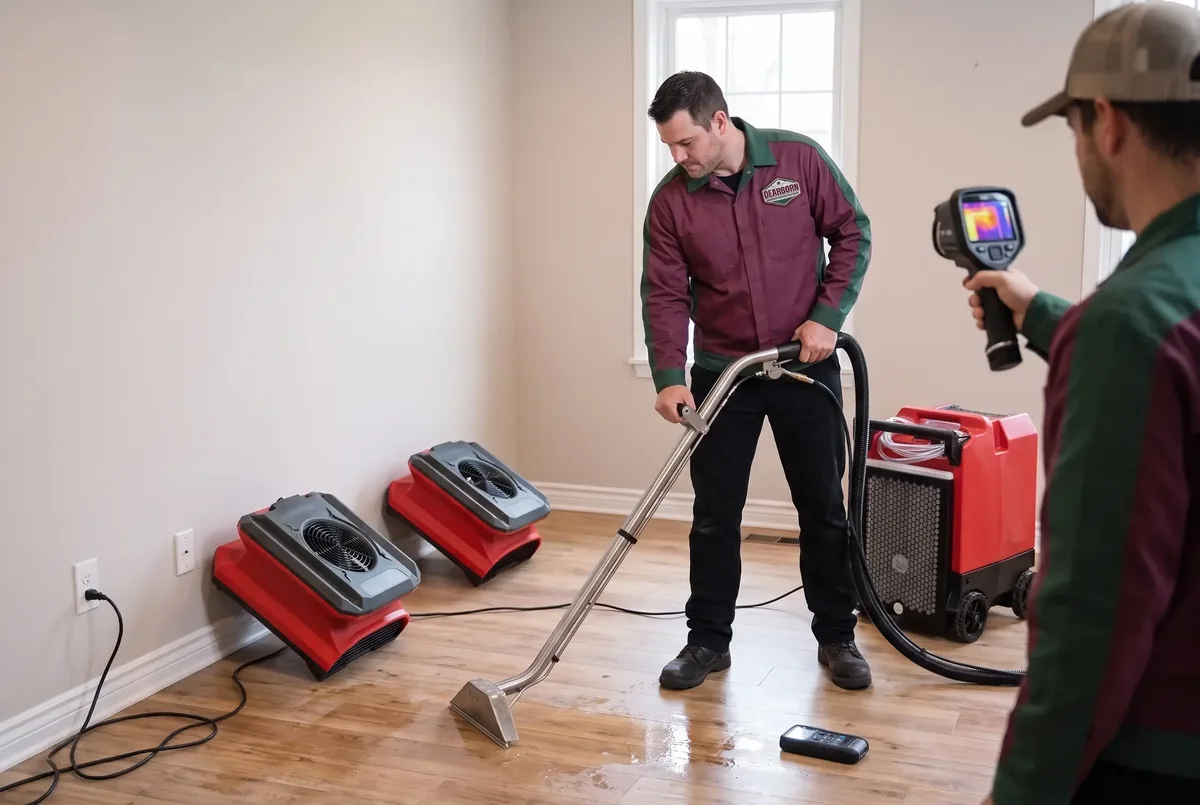
| Structural drying | Wall cavities, floors, and framing hold hidden water. We open small access holes when needed. Then we run airflow and dehumidifiers until moisture readings reach safe levels. |
| Sanitize and deodorize | We wash surfaces, apply a sanitizer, and remove damaged items. Fresh air flows through filters as we work. The house should smell clean when we finish. |
| Rebuild and document | Our final step is a repair scope and a document file. The file holds a timeline, photos, and readings. You can pass it to an adjuster or keep it for later. |
Hardware We Set Up
- Extractors: one truck-mounted, others portable
- Submersible pumps rated for dirty water
- Air movers in several sizes
- LGR dehumidifiers sized to the room
- Moisture meters for every material
- Thermal imaging cameras for walls and ceilings
- Hygrometers for air humidity
- Scrubbers that clean fine dust, HEPA type
The Path After Your Call
The call comes first, then a visit. During the visit, the crew studies the damage, protects your belongings, and begins extraction. Machines run in the affected rooms. Crew members come back to measure moisture and change the setup. When the readings look right, they remove the equipment and talk with you about repairs.
Questions, Answered
How long before help shows up?
It varies with distance, road conditions, and how busy the crews are. You will hear an estimate on your call. Stay reachable by phone. The team may call if they need entry details or are running late.
Do we have to leave?
Not always. The crew checks water type, room size, and air conditions. Small clean-water jobs often let you stay at home. Larger jobs or sewage backups may mean you sleep elsewhere until the work is done.
Roughly when will the house be dry?
No fixed time applies at the start. The result depends on the water amount, building materials, and indoor conditions. The crew takes readings on each return. When those numbers reach the dry goal, the equipment goes away.
Do you provide a loss record for insurers?
Yes. We build a record with timestamps, photos, and moisture data. You can pass it on to the adjuster. It shows our work, though only your insurer can say what the policy pays. Keep your own copy safe.
Before you arrive, what is the smartest move?
Make the area safe. Stop the water source, keep clear of electrical hazards, and move valuables to dry spots. Photograph all damage before touching it. Keep damaged items if you can, because the adjuster may want to see them.
What do city and county sources say on older homes in Dearborn?
The median home in Dearborn was built in 1952, so a typical house here carries 1950s plumbing and wiring.
What do city and county sources say on city help after a loss in Dearborn?
A FEMA hazard mitigation grant pays for about 6,200 feet of new storm sewer in Dearborn. FEMA covers 90 percent of cost and the city covers 10 percent.
What do city and county sources say on repair permits in Dearborn?
Selling a Dearborn home needs a city pre-sale inspection and a Certificate of Occupancy before closing, with all cited violations corrected and re-inspected.
Call us about water damage near Dearborn.
Contact (313) 462-2853 anytime.
For Dearborn, the typical response clocks in under 30 minutes. A crew starts moving toward your address as soon as you call.
Estimates are free, on every single call.
Every job is covered by a written guarantee built on finishing the job, not refunding it.